Enterprise B2B deals are won and lost on one critical capability: your ability to identify and engage every stakeholder who influences the buying decision. With the average enterprise deal involving 6-10 stakeholders and sales cycles taking 25% longer to close than five years ago, stakeholder mapping has evolved from a nice-to-have to a revenue-critical competency.
Yet most deals still stall because sales teams miss a key player—the CFO who never saw the business case, the InfoSec leader who raised concerns at the 11th hour, or the procurement officer who quietly deprioritized the project. These aren't outliers. They're predictable failures that result from incomplete stakeholder mapping.
This comprehensive guide provides a proven framework for building enterprise stakeholder maps that accelerate deals, reduce risk, and improve win rates in 2025.
Why Stakeholder Mapping Determines Enterprise Deal Outcomes
Enterprise buying decisions are fundamentally collaborative processes. Research shows that 89% of buyers are more likely to purchase when they feel understood, yet the average B2B deal now takes 1-2 full quarters to close, with 34% of revenue teams reporting sales cycles in this range.
The longer your deal drags, the worse your odds become. Deals that close within 50 days achieve a 47% win rate, while those extending beyond this threshold plummet to 20% or lower.
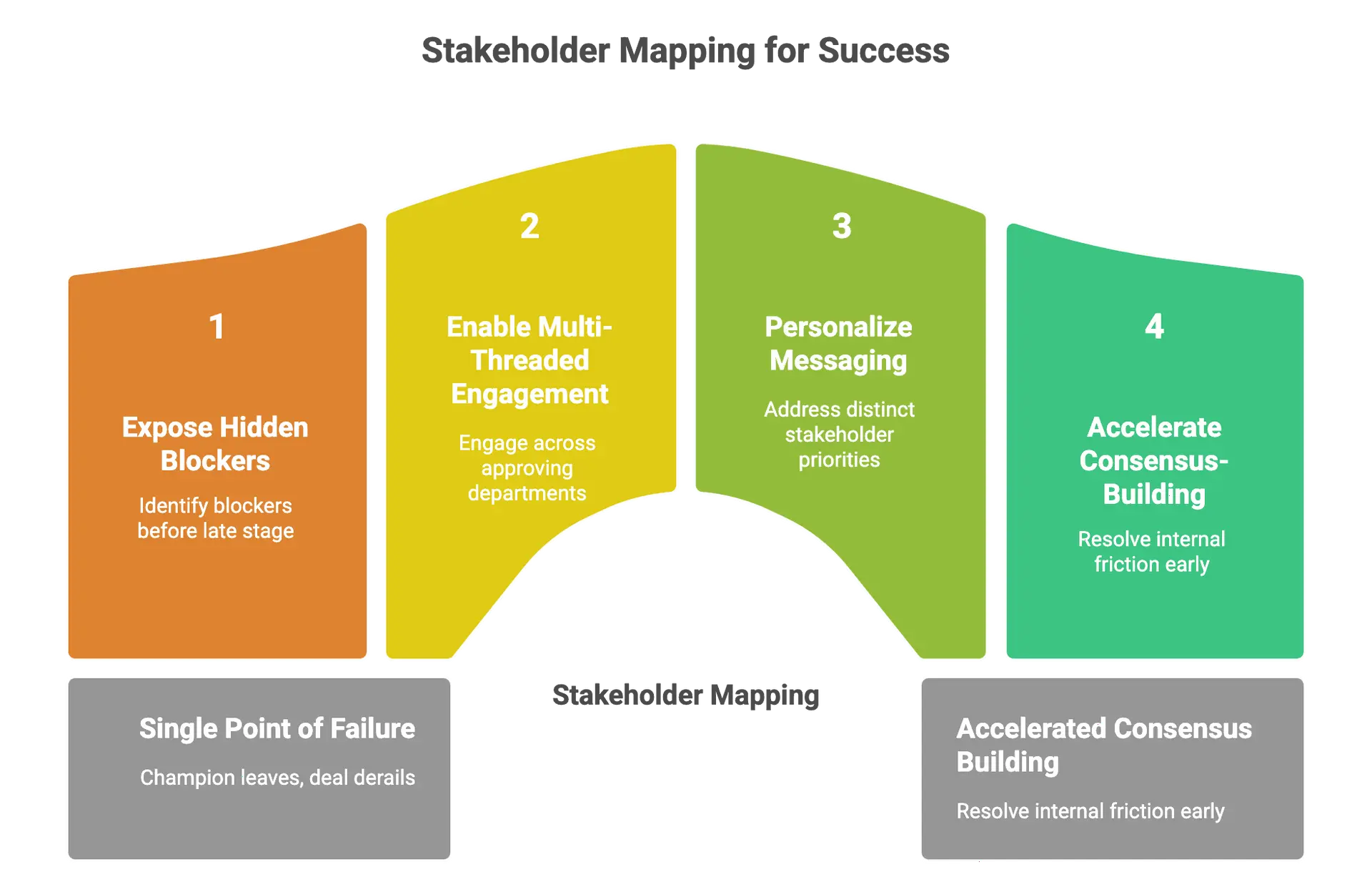
Stakeholder mapping directly addresses this challenge by:
Preventing single-point-of-failure risk when your champion leaves, gets promoted, or loses internal influence
Exposing hidden blockers before they derail your deal in late-stage evaluations
Enabling multi-threaded engagement across departments that must approve, implement, or fund your solution
Personalizing messaging to address the distinct priorities of finance, operations, IT, legal, and executive stakeholders
Accelerating consensus-building by identifying and resolving internal friction early
Without a systematic approach to stakeholder mapping, you're essentially flying blind through a complex organizational landscape, hoping your single contact can navigate internal politics on your behalf. They usually can't.
The 8 Critical Stakeholder Roles in Enterprise B2B Buying Committees
Before you can map stakeholders, you need to understand the distinct roles they play in enterprise purchasing decisions. Each role has different motivations, concerns, and influence levels.
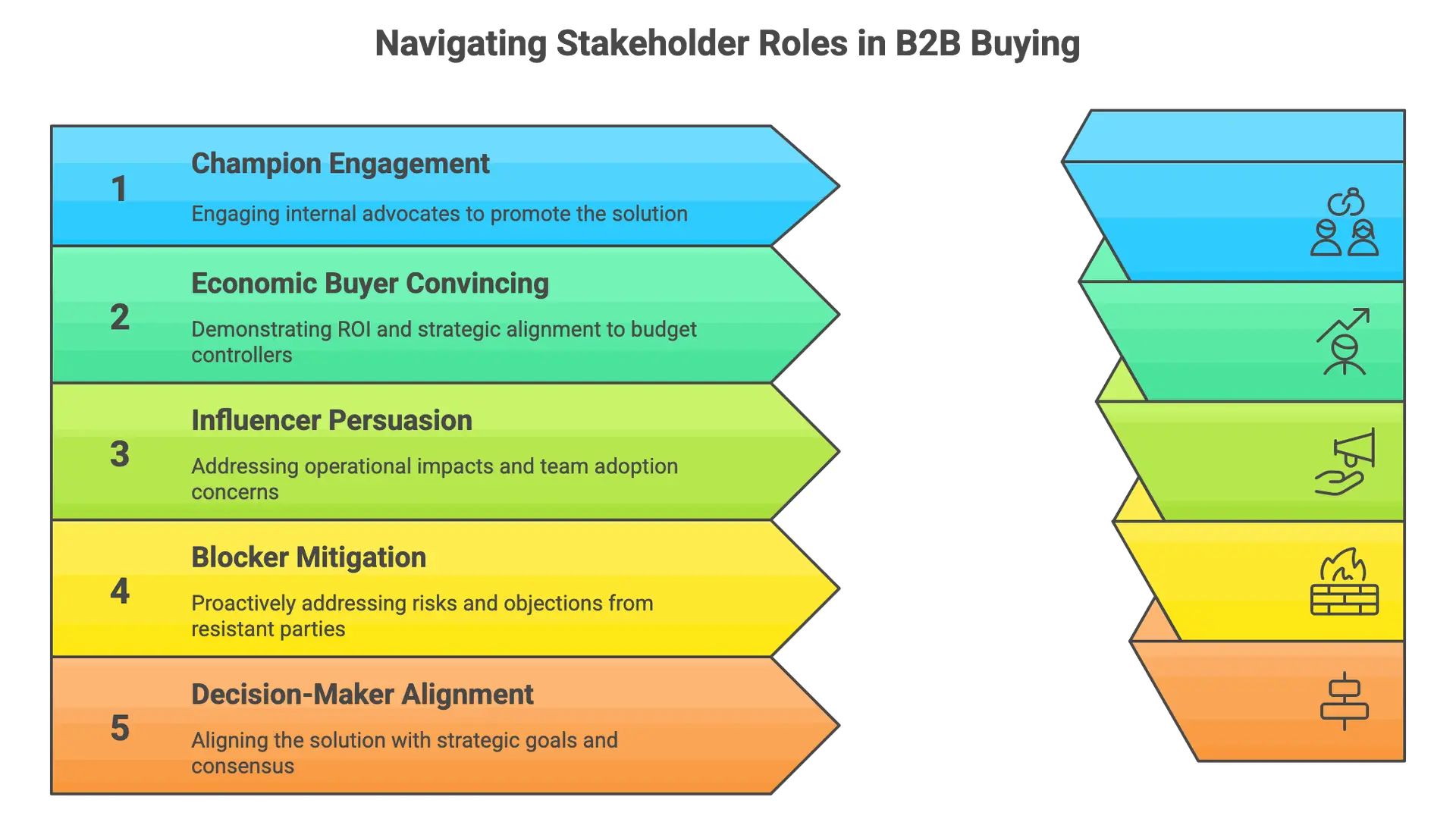
1. The Champion
Champions are your internal advocates who actively promote your solution within their organization. They benefit directly from solving the problem—often through productivity gains, departmental wins, or career advancement.
What they care about: Proving the value of the initiative, looking good internally, and achieving their team's objectives
How to identify them: They proactively schedule meetings, ask detailed questions about implementation, and openly discuss internal challenges
Engagement strategy: Equip them with stakeholder-specific resources, ROI calculators, competitive battle cards, and internal selling materials they can use to advocate on your behalf
Critical mistake to avoid: Over-relying on a single champion without building relationships across the buying committee. When champions lack authority with finance, IT, or procurement, deals freeze regardless of their enthusiasm.
2. The Economic Buyer
Economic buyers control the budget and make final purchasing decisions based on business outcomes and ROI. They're typically VP-level or C-suite executives who evaluate whether your solution justifies the financial investment.
What they care about: Business outcomes, return on investment, strategic alignment, and opportunity cost
How to identify them: Ask your champion "Who ultimately approves the budget for this initiative?" and "Whose signature is required on the contract?"
Engagement strategy: Focus on quantified business impact, payback period, and how your solution supports their strategic objectives. Avoid feature-focused presentations.
Key insight: Economic buyers often aren't directly impacted by your product but must be convinced that the investment will generate meaningful returns for the organization.
3. The Influencer
Influencers are respected voices whose opinions carry significant weight with decision-makers. They might be subject matter experts, long-tenured employees, or leaders whose departments will be most affected by your solution.
What they care about: Operational impact, team adoption, disruption to existing workflows, and whether the solution actually solves the stated problem
How to identify them: Listen for phrases like "We should run this by [name]" or "The team won't move forward without [person's] approval"
Engagement strategy: Demonstrate deep understanding of their day-to-day challenges and provide proof that similar teams have successfully implemented your solution
Common scenario: In marketing automation deals, the Head of Marketing Operations often serves as an influencer because they'll oversee daily platform usage and integration with existing systems.
4. The Blocker
Blockers resist your solution due to concerns about risk, disruption, budget allocation, or preference for alternative options. They can be found in IT, security, compliance, legal, or competing departments.
What they care about: Risk mitigation, maintaining stability, protecting their domain, or advocating for a different solution
How to identify them: Ask "Who might have concerns about this type of change?" and "Which departments have pushed back on similar initiatives?"
Engagement strategy: Address their objections proactively with security documentation, compliance certifications, integration roadmaps, and risk mitigation plans. Don't avoid blockers—engage them early.
Critical warning: Blockers identified late in the sales cycle can single-handedly kill deals. InfoSec raising data storage concerns at contract stage or IT flagging integration risks during procurement are predictable scenarios that result from poor stakeholder mapping.
5. Decision-Maker
Decision-makers have formal authority to approve or reject the purchase. In enterprise deals, this might be a single executive or a collective decision-making unit spanning multiple departments.
What they care about: Strategic fit, consensus among their team, risk management, and whether the initiative supports broader organizational goals
How to identify them: They're typically C-level or senior VPs who chair evaluation committees or whose approval is explicitly required
Engagement strategy: Bring in executive stakeholders from your organization for peer-to-peer conversations. Show how your solution aligns with their publicly stated priorities.
Multi-threading principle: Even if your champion is a decision-maker, deals are safer when you have 4-5 active contacts across departments.
6. End Users
End users are the individuals who will directly interact with your product or service. Their feedback significantly influences whether the buying committee perceives your solution as practical and adoptable.
What they care about: Usability, learning curve, impact on their daily work, and whether the tool actually makes their jobs easier
How to identify them: Ask "Which teams will use this solution day-to-day?" and "Who should participate in the technical evaluation?"
Engagement strategy: Offer hands-on product trials, use-case specific demos, and implementation support that addresses their workflow concerns
Bottom-up influence: While end users rarely have final decision authority, negative feedback from this group can torpedo deals by creating adoption risk concerns among executives.
7. Gatekeepers
Gatekeepers control access to decision-makers and regulate when and how communication occurs. They might be executive assistants, procurement officers, or department heads who screen vendor interactions.
What they care about: Protecting their executive's time, ensuring proper processes are followed, and filtering out low-quality vendors
How to identify them: They're often your first point of contact when attempting to reach senior executives
Engagement strategy: Respect their role, demonstrate value concisely, and leverage your champion to facilitate introductions rather than trying to bypass gatekeepers
8. Executive Sponsor
Executive sponsors support the initiative from a strategic perspective and often serve as internal advocates at the leadership level. They may overlap with economic buyers but are distinguished by their active promotion of the project.
What they care about: Strategic impact, organizational transformation, and ensuring their sponsored initiatives succeed
How to identify them: Ask "Who internally is driving this initiative?" and "Which executive would consider this a priority?"
Engagement strategy: Align your solution to their publicly stated goals, quarterly objectives, or transformation initiatives mentioned in earnings calls or company communications
5-Step Framework for Enterprise Stakeholder Mapping
Building an accurate stakeholder map requires systematic research and continuous refinement throughout the sales cycle. Here's the proven framework enterprise sales teams use to map complex buying committees.
Step 1: Start with Outcome-Based Stakeholder Identification
Most sellers make the critical mistake of starting with "Who do I know?" instead of "Who must be involved for this outcome to happen?"
Begin by defining the business outcome your prospect is trying to achieve. If the goal is "reduce customer onboarding time by 30%," then Finance (budget approval), IT/Security (system integration), Customer Success (execution), and Operations (process change) are automatically implicated—even if you haven't met them yet.
This outcome-based approach prevents the common failure of being blindsided by departments that "always weigh in late, usually with veto power."
Action steps:
- Document the specific business outcome driving this purchase
- List every department that must participate in achieving that outcome
- Identify which functions typically approve similar initiatives (IT, Security, Legal, Procurement, Finance)
- Create your initial stakeholder framework before you start naming specific individuals
Step 2: Map the Organizational Structure Through Research
Use multiple research channels to build a comprehensive view of your target account's structure:
Company website research: Review the "About Us," "Leadership Team," and "Our Team" pages to identify C-suite executives, VPs, and department heads. Press releases often announce leadership changes, new initiatives, or strategic priorities that reveal key players.
LinkedIn Sales Navigator: Use advanced search to filter by company, job title, department, and seniority level. Look for decision-maker titles like CEO, CFO, CIO, CTO, VP of Sales, VP of Operations, and department heads relevant to your solution.
LinkedIn organizational insights: Review the "People" section of the company's LinkedIn page to see employee distribution across departments and identify reporting structures.
ZoomInfo, Apollo, and Cognism: Leverage B2B intelligence platforms that provide organizational charts, contact information, reporting structures, and technographic data showing what tools the company currently uses.
CRM historical data: Check your CRM for previous interactions with this account. Who has your team engaged in the past? What roles were involved in previous purchasing decisions?
Annual reports and earnings calls: For public companies, these documents reveal strategic priorities, transformation initiatives, and which executives are leading key projects.
Industry publications and news: Track company announcements, acquisitions, funding rounds, and leadership changes that signal buying intent or reveal stakeholder changes.
Tip: Create a preliminary org chart that shows departments, likely stakeholders, and reporting relationships even before you have specific names. This framework guides your discovery conversations.
intellisell.ai plug 😁
Skip hours of drudging research - build Customer 360° instantly
intellisell's Sales tuned AI aggregates data across hundreds of targeted data points, and provides comprehensive insights about your prospects and stakeholders.
Start using intellisell.ai for FREE
Step 3: Leverage Your Champion to Validate and Expand Your Map
Your champion is your inside source for understanding the true decision-making dynamics. Use strategic questioning to build an accurate stakeholder map collaboratively.
Questions to ask your champion:
Discovery questions:
- "Who else typically gets involved in purchasing decisions like this?"
- "Which departments need to approve this type of initiative?"
- "Who was involved the last time you evaluated similar solutions?"
- "Who internally is driving this as a priority?"
Influence and authority questions:
- "Who has the final say on budget allocation?"
- "Whose opinion carries the most weight in these decisions?"
- "Are there any executives who would need to sign off?"
- "Who would you consider the ultimate decision-maker?"
Blocker identification questions:
- "Which teams might have concerns about this type of change?"
- "Has IT or Security raised any requirements for new software?"
- "Are there any individuals or departments that have blocked similar projects?"
- "Who might prefer a different approach or solution?"
Political landscape questions:
- "Are there any competing priorities or internal disagreements we should be aware of?"
- "How well do the key stakeholders work together?"
- "Are there any sensitivities around budget ownership or department responsibilities?"
Process and timeline questions:
- "What does your internal approval process typically look like?"
- "Who needs to review the contract before it's finalized?"
- "When do Finance and Legal typically get involved?"
Collaborative mapping approach: Share your preliminary stakeholder map with your champion and ask them to validate, correct, and expand it. Use collaborative tools like Miro, Figma, Notion, or Airtable to create visual maps you can update together.
Step 4: Apply the RACI Framework to Clarify Roles and Influence
The RACI matrix is a powerful tool for understanding each stakeholder's role in the decision-making process:
R - Responsible: Who is responsible for evaluating the solution and driving the initiative forward? (Often your champion or influencers)
A - Accountable: Who is ultimately accountable for the decision and outcome? (The economic buyer or decision-maker)
C - Consulted: Who must be consulted and provide input before decisions are made? (Influencers, subject matter experts, department heads)
I - Informed: Who needs to be kept informed about progress but doesn't directly influence the decision? (Adjacent stakeholders, implementation teams)
Create a RACI matrix that maps each key task in your sales process (evaluation, technical review, security assessment, contract negotiation, budget approval) against your identified stakeholders.
Example RACI Matrix for Enterprise Software Purchase:
| Task/Stage | Champion (Ops Director) | CIO | CISO | CFO | Procurement | End Users |
| Problem identification | R | I | - | - | - | C |
| Solution evaluation | A | C | C | I | - | R |
| Technical assessment | C | A | R | - | - | C |
| Security review | I | C | A | I | - | - |
| Business case development | R | C | - | C | - | - |
| Budget approval | - | C | - | A | I | - |
| Contract negotiation | I | - | - | C | R | - |
| Final decision | C | C | C | A | - | - |
This clarity prevents confusion about who needs to be involved at each stage and ensures you're engaging the right stakeholders at the right time.
Step 5: Prioritize Stakeholders Using Power/Interest Mapping
Not all stakeholders require equal attention. Use a Power/Interest Grid to prioritize your engagement strategy:
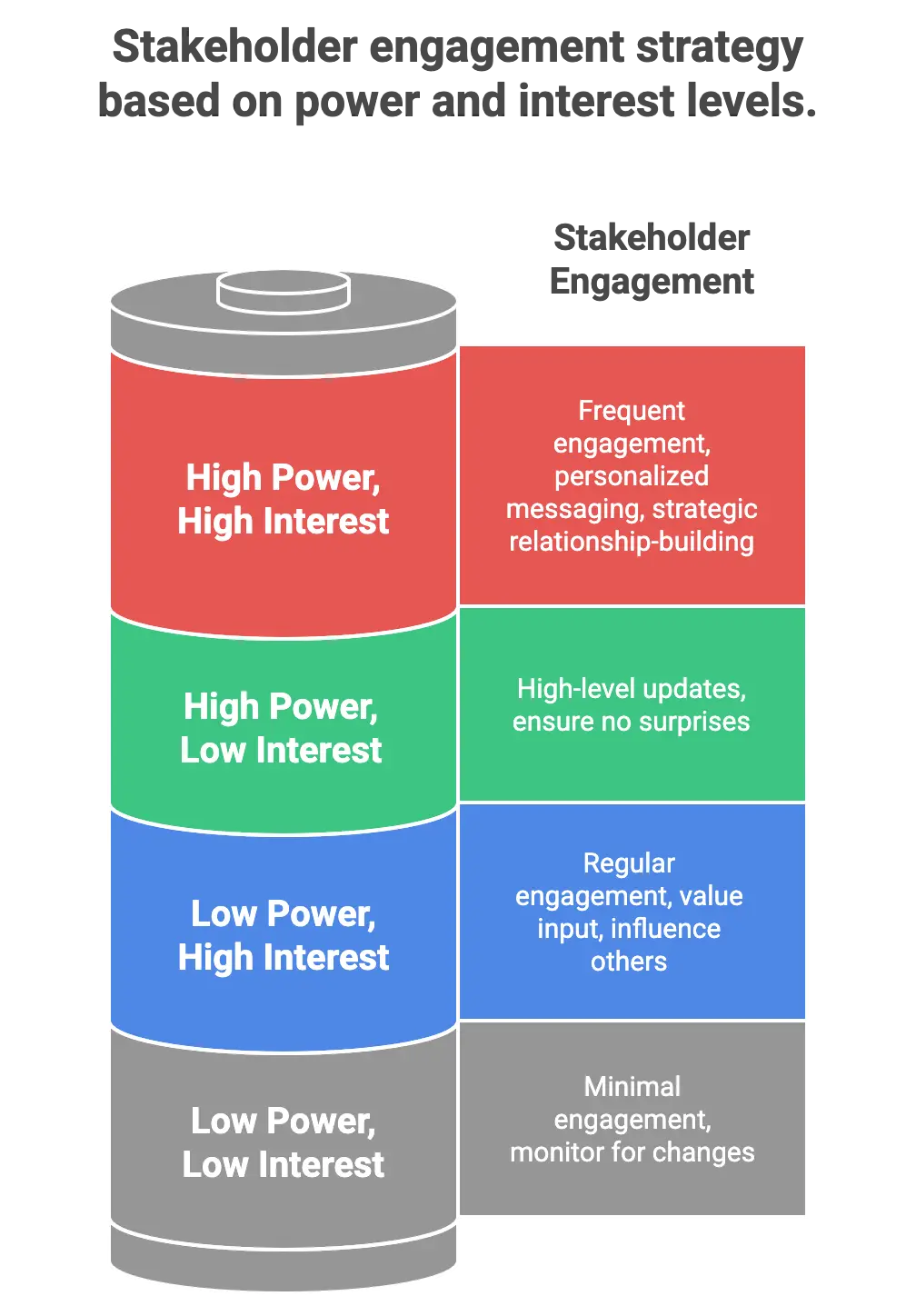
High Power, High Interest (Key Players): These are your priority stakeholders requiring frequent engagement, personalized messaging, and strategic relationship-building. Typically includes economic buyers, decision-makers, and strong influencers.
High Power, Low Interest (Keep Satisfied): Important stakeholders who must approve but aren't deeply engaged in evaluation. Keep them informed with high-level updates and ensure no surprises. Often includes CFOs, Legal, and executives outside the primary buying team.
Low Power, High Interest (Keep Informed): Engaged stakeholders who lack final authority but provide valuable input and can influence others. Includes end users, champions without budget authority, and department advocates. Engage regularly but don't over-invest executive time.
Low Power, Low Interest (Monitor): Peripheral stakeholders who need minimal engagement. Monitor for changes in influence or interest but don't prioritize active outreach.
Practical application: Create a visual stakeholder map plotting each person on the Power/Interest Grid. Update this quarterly or after significant organizational changes.
Advanced Stakeholder Mapping Strategies for Complex Deals
Multi-Threading: Building Redundancy Across the Buying Committee
Relying on a single champion is the most common cause of deal failure. Multi-threading—developing relationships with 4-5 stakeholders across different departments—creates deal resilience and accelerates consensus-building.
Multi-threading strategies:
Cross-functional engagement: Ensure you have active relationships in at least three different departments (e.g., Operations, IT, and Finance)
Peer-to-peer matching: Connect your executive stakeholders with their executive counterparts, your technical team with their technical evaluators, and your success team with their implementation leads
Simultaneous outreach: Run parallel engagement tracks rather than sequential handoffs. While your AE engages the economic buyer, your solutions engineer should be working with IT, and your CS leader should be connecting with implementation teams
Champion development at multiple levels: Identify and nurture champions at different organizational levels who can advocate in different forums
Risk mitigation: If your primary champion leaves or loses influence, your deal doesn't collapse because you have established relationships across the organization
Identifying and Engaging Hidden Stakeholders
The most dangerous stakeholders are the ones you don't know exist until they kill your deal.
Common hidden stakeholders in enterprise deals:
InfoSec/Cybersecurity teams who raise data protection concerns during contract review
Compliance officers who flag regulatory requirements you didn't address
IT architecture teams who identify integration challenges in late-stage technical reviews
Procurement specialists who enforce vendor management policies or negotiate aggressively
Finance controllers who question ROI calculations or budget allocation
Adjacent department leaders whose budgets or responsibilities might be affected
Proactive identification strategies:
Ask your champion explicitly: "Who else has stopped or slowed similar initiatives in the past?"
Research the company's website and LinkedIn for Security, Compliance, IT Architecture, and Procurement leaders
Prepare standard resources (security questionnaires, compliance documentation, integration specs) before these stakeholders surface
Include questions in your discovery process like "What's your security review process?" and "Does Procurement typically get involved?"
Customizing Messaging for Different Stakeholder Personas
Generic messaging fails in enterprise sales because different stakeholders care about fundamentally different outcomes.
Persona-specific messaging framework:
For Economic Buyers (CFO, CEO, Business Unit Leaders):
- Focus: ROI, payback period, strategic impact, competitive advantage
- Proof points: Business case studies, total cost of ownership analysis, financial projections
- Content formats: Executive summaries, board-ready presentations, analyst reports
For IT/Technical Stakeholders (CIO, CTO, IT Directors):
- Focus: Architecture fit, integration complexity, technical scalability, support model
- Proof points: Technical documentation, integration guides, architecture diagrams, API capabilities
- Content formats: Technical whitepapers, solution architecture reviews, developer documentation
For Security/Compliance (CISO, InfoSec, Compliance Officers):
- Focus: Data protection, compliance certifications, security controls, risk mitigation
- Proof points: SOC 2 reports, ISO certifications, security whitepapers, penetration test results
- Content formats: Security questionnaire responses, compliance matrices, audit reports
For Operational Leaders (VP Operations, Department Heads):
- Focus: Process improvement, efficiency gains, team productivity, implementation timeline
- Proof points: Process improvement case studies, time-to-value metrics, implementation plans
- Content formats: Use case presentations, process flow comparisons, change management guides
For End Users (Managers, Individual Contributors):
- Focus: Usability, workflow impact, learning curve, day-to-day benefits
- Proof points: Product demos, user testimonials, training resources, adoption metrics
- Content formats: Hands-on trials, tutorial videos, quick-start guides
For Procurement (Procurement Officers, Contract Managers):
- Focus: Contract terms, pricing transparency, vendor stability, service level agreements
- Proof points: Reference customers, financial stability indicators, flexible contract structures
- Content formats: Standard contract templates, SLA documentation, vendor profiles
Implementation tip: Create modular presentation decks with stakeholder-specific sections you can mix and match based on who's in the meeting.
7 Critical Stakeholder Mapping Mistakes That Kill Enterprise Deals
Mistake 1: Confusing Job Titles with Actual Influence
A VP title doesn't guarantee decision-making authority. Internal politics, budget controls, and cross-functional dynamics determine real influence.
Example: A VP of Operations championed a solution but lacked authority with the CFO. The deal stalled for 45 days when Procurement got involved because the champion had no visibility into the approval process.
Fix: Don't map the org chart—map the deal reality. Ask "Who typically signs off?" and "Who challenges this type of purchase?" Track who attends meetings, asks tough questions, and who your champion defers to.
Mistake 2: Relying Exclusively on a Single Champion
Even strong champions can't navigate Finance, IT, Legal, and Procurement politics alone—especially if they lack formal authority in those domains.
Fix: Multi-thread early. Build relationships with 4-5 contacts across departments. Ask your champion "Who else will weigh in?" and "Would it help to bring IT into the conversation?"
Mistake 3: Ignoring Cross-Functional Stakeholders
Sales teams often engage only the user department (Sales, Marketing, Operations) while ignoring Finance, Legal, Procurement, and IT—who frequently join late with deal-blocking concerns.
Example: A data platform vendor skipped InfoSec involvement. At contract stage, Security flagged data storage concerns and the deal paused for re-review.
Fix: Pre-map all likely departments based on your product category. Prepare department-specific resources (security docs, compliance checklists, ROI justifications) before they're requested.
Mistake 4: Using Identical Messaging for Every Stakeholder
CFOs care about business outcomes. IT cares about security and integration. End users care about usability. Using the same presentation for everyone creates disengagement.
Fix: Tailor your narrative to each stakeholder's priorities. Create modular content you can customize by persona. Ask each stakeholder "What does success look like for you if this moves forward?"
Mistake 5: Creating Static Maps for Long Sales Cycles
People get promoted, replaced, or added to evaluation committees throughout lengthy enterprise sales cycles. Outdated maps lead to missed stakeholders and broken relationships.
Example: A Director of Ops left mid-deal and a new VP joined. The rep wasn't aware and never restarted the conversation—the new VP deprioritized the project.
Fix: Update your stakeholder map after every major touchpoint. Use your CRM to track changes in names, titles, concerns, and influence levels. Ask periodically "Has anyone new joined the evaluation process?"
Mistake 6: Overlooking Internal Friction Between Departments
Buying committees aren't unified teams—they're collections of individuals with competing interests, budget battles, and political tensions. Ignoring these dynamics creates unexpected resistance.
Example: Sales wanted CRM automation but IT resisted due to integration costs. No one addressed the disconnect and the deal lost momentum.
Fix: Ask early "Are there any internal concerns that could impact this?" Help your champion align stakeholders with objection-handling docs, side-by-side comparisons, and internal FAQ resources.
Mistake 7: Failing to Identify Blockers Until Late Stage
Blockers who surface in late-stage evaluations can single-handedly kill deals because you haven't had time to address their concerns or build relationships.
Fix: Explicitly ask "Who might have reservations about this type of change?" and "Which teams have blocked similar initiatives?" Engage potential blockers proactively with risk mitigation resources.
Tools and Templates for Enterprise Stakeholder Mapping
Essential Tools
LinkedIn Sales Navigator: Advanced search and organizational insights for identifying decision-makers and understanding company structure
ZoomInfo, Apollo, Cognism: B2B intelligence platforms providing org charts, contact data, and buying signals
CRM systems (Salesforce, HubSpot): Centralized stakeholder tracking, relationship history, and engagement analytics
Collaborative mapping tools (Miro, Figma, Notion, Airtable): Visual stakeholder mapping, RACI matrices, and shared account plans
Conversation intelligence (Gong, Chorus): Call analysis to identify mentioned stakeholders and concerns in customer conversations
AI-powered research platforms (intellisell.ai): Tools that automate prospect research by aggregating company intelligence, stakeholder identification, and relevant insights
Stakeholder Mapping Template Structure
Create a comprehensive stakeholder map that includes:
Stakeholder identification:
- Name, title, department
- Role in buying committee (Champion, Economic Buyer, Influencer, Blocker, Decision-Maker, End User)
- RACI designation for key decision stages
Influence analysis:
- Power level (High/Medium/Low)
- Interest level (High/Medium/Low)
- Attitude toward your solution (Advocate/Neutral/Skeptic/Blocker)
Engagement tracking:
- Last contact date and method
- Key concerns or priorities
- Resources shared
- Next planned touchpoint
Relationship strength:
- Engagement level (Active/Occasional/Unengaged)
- Relationship quality (Strong/Developing/Weak/None)
- Multi-threading connections (who else on your team has engaged them)
Strategic notes:
- Personal interests or background
- Communication preferences
- Internal relationships and political dynamics
- Tailored value propositions for this stakeholder
Putting Your Stakeholder Map Into Action
A stakeholder map is only valuable if it drives action. Here's how to operationalize your mapping work:
Integrate stakeholder mapping into your sales process: Make mapping a required qualification step before moving deals to advanced stages
Review and update maps in every deal review: Dedicate time in pipeline reviews to stakeholder analysis, not just revenue forecasting
Create stakeholder-specific action plans: For each key stakeholder, document your engagement strategy, next steps, and success criteria
Assign multi-threading responsibilities: Ensure multiple team members have stakeholder engagement responsibilities (AE owns Economic Buyer, SE owns IT/Technical, CSM owns End Users/Implementation)
Build stakeholder engagement into mutual action plans: Include stakeholder alignment as explicit milestones in your joint success plans with customers
Use stakeholder insights to forecast accurately: Deals with complete stakeholder maps, multi-threaded relationships, and engaged economic buyers forecast more reliably
Conduct post-mortem analysis: Review stakeholder maps for won and lost deals to identify patterns and improve future mapping
The Bottom Line: Stakeholder Mapping Drives Enterprise Revenue
Enterprise deals are won through systematic stakeholder engagement, not heroic individual selling. As buying committees grow larger and sales cycles extend, your ability to identify, understand, and engage every stakeholder who influences the decision becomes the primary determinant of deal outcomes.
The most successful enterprise sales teams treat stakeholder mapping as a continuous discipline, not a one-time exercise. They build redundancy through multi-threading, personalize engagement by persona, and proactively surface hidden stakeholders before they become deal blockers.
In 2025's complex B2B environment, stakeholder mapping isn't just about closing individual deals faster—it's about building the organizational intelligence and engagement discipline that drives predictable, scalable enterprise revenue growth.
Start by implementing the five-step framework in your next enterprise opportunity. Map stakeholders outcome-first, research organizational structures systematically, validate with your champion, apply RACI clarity, and prioritize based on power and interest. Update your maps continuously and measure the impact on sales cycle length and win rates.
The teams that master enterprise stakeholder mapping don't just win more deals—they win them faster, with higher contract values, and with stronger customer relationships that drive expansion revenue for years to come.
